Trapped in Your Own Home: The Leasehold Racket That Turned British Homeownership Into a Lie

You Bought the Flat. You Don't Own It.
Imagine saving for a decade, scraping together a deposit, navigating mortgage applications, and finally — finally — buying your own home. Now imagine receiving a letter twelve months later informing you that your ground rent has doubled, that a service charge covering unspecified 'maintenance' has been levied at £3,000 for the year, and that any challenge to these charges will require you to fund legal proceedings that could cost more than the charges themselves. Welcome to leasehold Britain — where owning a home and actually controlling it are two entirely different things.
This is not a fringe experience. According to government figures, there are approximately 4.98 million leasehold dwellings in England alone, the vast majority of them flats. First-time buyers — disproportionately younger, less wealthy, and more likely to be purchasing new-build properties — are the demographic most exposed to these arrangements. The leasehold system is, in practice, a mechanism through which wealth flows steadily and legally from people who work for a living to investment companies, aristocratic estates, and property management firms that operate with minimal regulatory oversight and near-total impunity.
How the Trap Is Set
The mechanics of leasehold exploitation are worth spelling out plainly, because the complexity of the system is itself a feature rather than a bug — it obscures what is, at root, a straightforward extraction.
When you buy a leasehold property, you are purchasing the right to occupy it for a fixed term — often 99, 125, or 999 years — while the freehold (the actual land and structure) remains owned by a separate party. That freeholder can charge you ground rent simply for existing in your home. They can levy service charges for the upkeep of communal areas, often through a managing agent they have appointed and who is answerable primarily to them. They can refuse permission for alterations to your own property — a new bathroom, a conservatory, even sometimes a pet — and charge you for the privilege of requesting that permission.
Perhaps most insidiously, they can sell the freehold to another entity without your knowledge or consent. Leaseholders have discovered that the company they originally contracted with has been replaced by an offshore investment vehicle, registered in the British Virgin Islands, which now controls the terms under which they occupy their own home.
 Photo: British Virgin Islands, via www.travelandleisure.com
The Competition and Markets Authority, in its 2020 report on the leasehold sector, found evidence of 'unjustified' ground rent terms, inadequate disclosure of charges at the point of sale, and systemic failures by developers and conveyancers to explain the full implications of leasehold ownership to buyers. That report was published five years ago. The exploitation has continued.
 Photo: Competition and Markets Authority, via c8.alamy.com
Reform Promised, Reform Delayed
The political history of leasehold reform is a masterclass in how Westminster manages to appear responsive to public concern while protecting the interests of those who benefit from the status quo.
The Leasehold Reform (Ground Rent) Act 2022 abolished ground rents for new residential leases — a genuine, if partial, step forward. The previous Conservative government also promised a more comprehensive Leasehold and Freehold Reform Act, which eventually passed in 2024 but was widely criticised by campaigners for falling short of the substantive change required. The legislation did not deliver commonhold — the system used across much of Europe, under which flat owners collectively own the building rather than leasing it from a third party — as the primary tenure for new developments.
Labour came to power with commitments to go further. Progress has been slow. The property industry, which has historically donated generously to political parties across the spectrum, maintains considerable influence over the pace and ambition of reform.
The Communities Paying the Price
The demographics of leasehold victimhood are not random. New-build estates on the edges of northern and midland towns — marketed aggressively to first-time buyers through Help to Buy and similar schemes — were frequently sold as leaseholds, sometimes with ground rents structured to double every ten years. The buyers were young, often without independent legal advice, and frequently unaware of what they were signing.
The National Leasehold Campaign, which represents tens of thousands of affected homeowners, has documented cases of families unable to sell their properties because mortgage lenders will not approve loans on homes with onerous ground rent clauses. People are trapped — unable to leave, unable to afford to stay, and unable to afford the legal costs of fighting back.
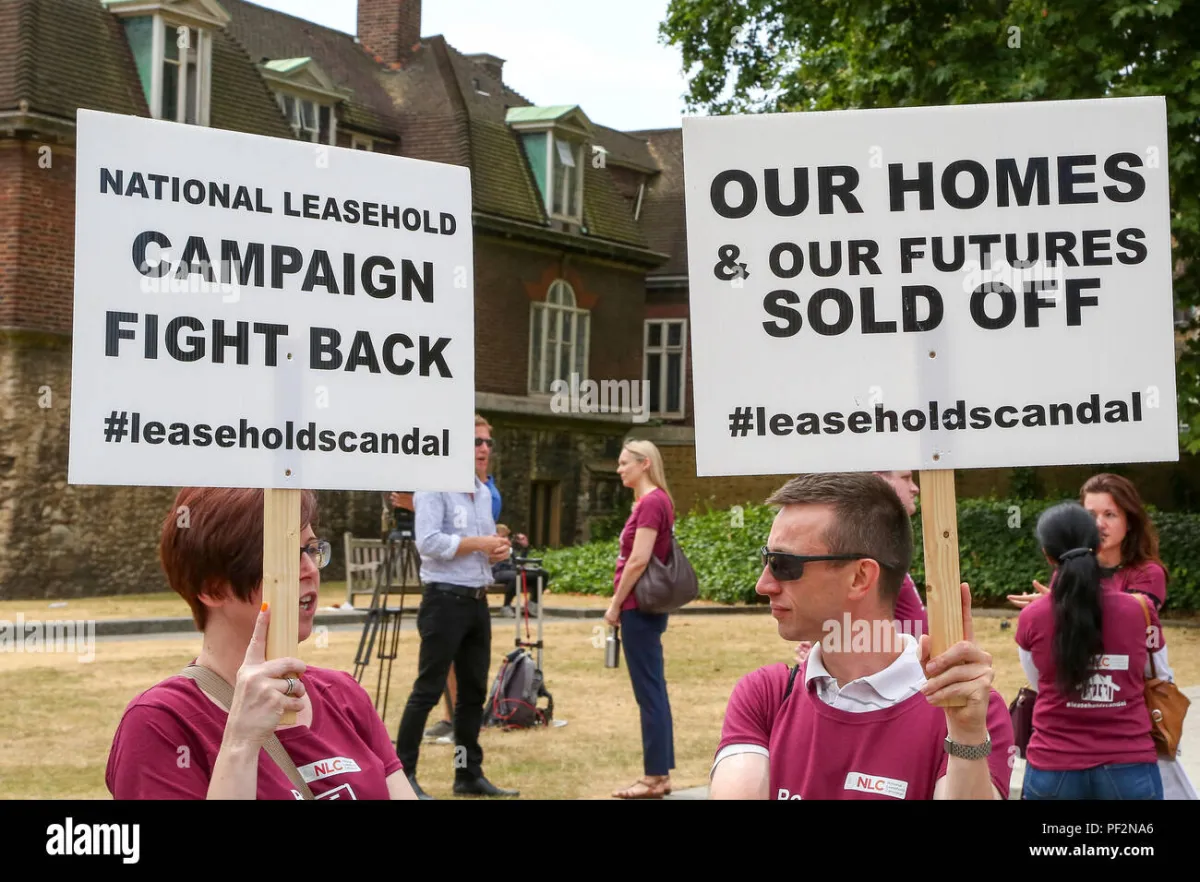 Photo: National Leasehold Campaign, via c8.alamy.com
This is not a middle-class inconvenience. For many families, the equity locked in their home is their primary financial asset. When that asset is rendered unsellable by a ground rent clause inserted by a developer who has since dissolved the subsidiary company that issued it, the financial damage is catastrophic and the legal redress is, in practice, non-existent.
The System Doesn't Fail — It Works Exactly as Designed
It would be comforting to attribute the leasehold scandal to regulatory failure or administrative oversight. The more honest assessment is that the system has functioned precisely as its architects intended. Feudal property law, never fully dismantled after the postwar reforms that ended copyhold tenure, was permitted to persist and adapt — colonising the new-build market, attracting institutional investment, and generating returns for freeholders who contribute nothing to the maintenance or improvement of the properties they nominally own.
Successive governments, both Conservative and Labour, have chosen incremental tinkering over structural reform. The reason is not complexity. It is that the people who benefit from the current system are politically connected, financially powerful, and adept at framing any meaningful reform as an attack on property rights and investment confidence.
Real homeownership — the kind that means something, the kind that provides security and autonomy — must be built on a foundation of genuine ownership. Until commonhold becomes the default tenure for new developments, and until existing leaseholders are given an affordable, enforceable route to enfranchisement, millions of British families will continue to pay a monthly subscription fee to a landlord they never chose, for a home they were told was theirs.