One in Four Children Is Growing Up Poor in Britain — and We Have Decided That Is Fine
The Numbers That Should End Careers
The Joseph Rowntree Foundation's 2024 UK Poverty report placed the number of children living in poverty at approximately 4.3 million — roughly 30 per cent of all children in the United Kingdom. That is not a rounding error or a statistical artefact. It is nearly one in three children growing up in households that cannot reliably meet their basic needs: adequate food, warm clothing, a home free from damp, the school trips and birthday parties that mark out a childhood as normal rather than exceptional.
These are not children born into a country without resources. The United Kingdom remains the sixth-largest economy on the planet. Its aggregate household wealth runs to tens of trillions of pounds. The poverty experienced by these children is not the poverty of national destitution — it is the poverty of political choice, of a distribution of resources so skewed toward those who already have that those who do not are left to make do with charity, foodbanks, and the goodwill of underfunded public services.
The Structural Engines of Deprivation
Child poverty in Britain does not fall from the sky. It is manufactured by a set of interlocking policy decisions that have accumulated over decades, each individually defensible to its architects, collectively catastrophic in effect.
Begin with wages. Real wages in the United Kingdom have stagnated for longer than in almost any comparable wealthy nation. The Resolution Foundation has documented that British workers experienced the longest sustained wage squeeze since the Napoleonic era following the 2008 financial crisis — a squeeze that was not reversed by the minimum wage increases of subsequent years, which remained insufficient to offset rising housing, food, and energy costs for families at the lower end of the income distribution.
Layer onto that the benefit freeze. Between 2016 and 2020, working-age benefits were frozen in cash terms while inflation continued to erode their real value. The Child Benefit freeze alone stripped billions from the incomes of families with children. When the freeze was eventually lifted, uprating was insufficient to recover the lost ground. The two-child limit — the policy that caps Child Tax Credit and Universal Credit for third and subsequent children — remains in place under Labour, despite overwhelming evidence from the JRF, Save the Children, and the Child Poverty Action Group that it is one of the single most effective drivers of deep child poverty.
Then there is housing. Rents in the private sector have risen at multiples of wage growth in almost every major British city. Housing Benefit, frozen at the 30th percentile of local rents for years, has left a growing gap between what the state contributes and what landlords charge — a gap that comes directly out of family budgets otherwise needed for food and heating.
What Poverty Does to a Child's Body and Mind
The political debate around child poverty tends toward abstraction — percentages, thresholds, definitions. The clinical literature is rather more concrete. Children growing up in persistent poverty are significantly more likely to experience stunted physical development, higher rates of chronic illness, elevated cortisol levels consistent with chronic stress, and substantially worse mental health outcomes than their more affluent peers.
A 2023 report from the Royal College of Paediatrics and Child Health linked food insecurity directly to increased presentations in A&E departments — children arriving in emergency care with conditions that adequate nutrition would have prevented or managed. Teachers across the country routinely report children arriving at school unable to concentrate because they have not eaten since the previous day's free school meal. School nurses describe children concealing hunger to avoid the stigma of being identified as poor.
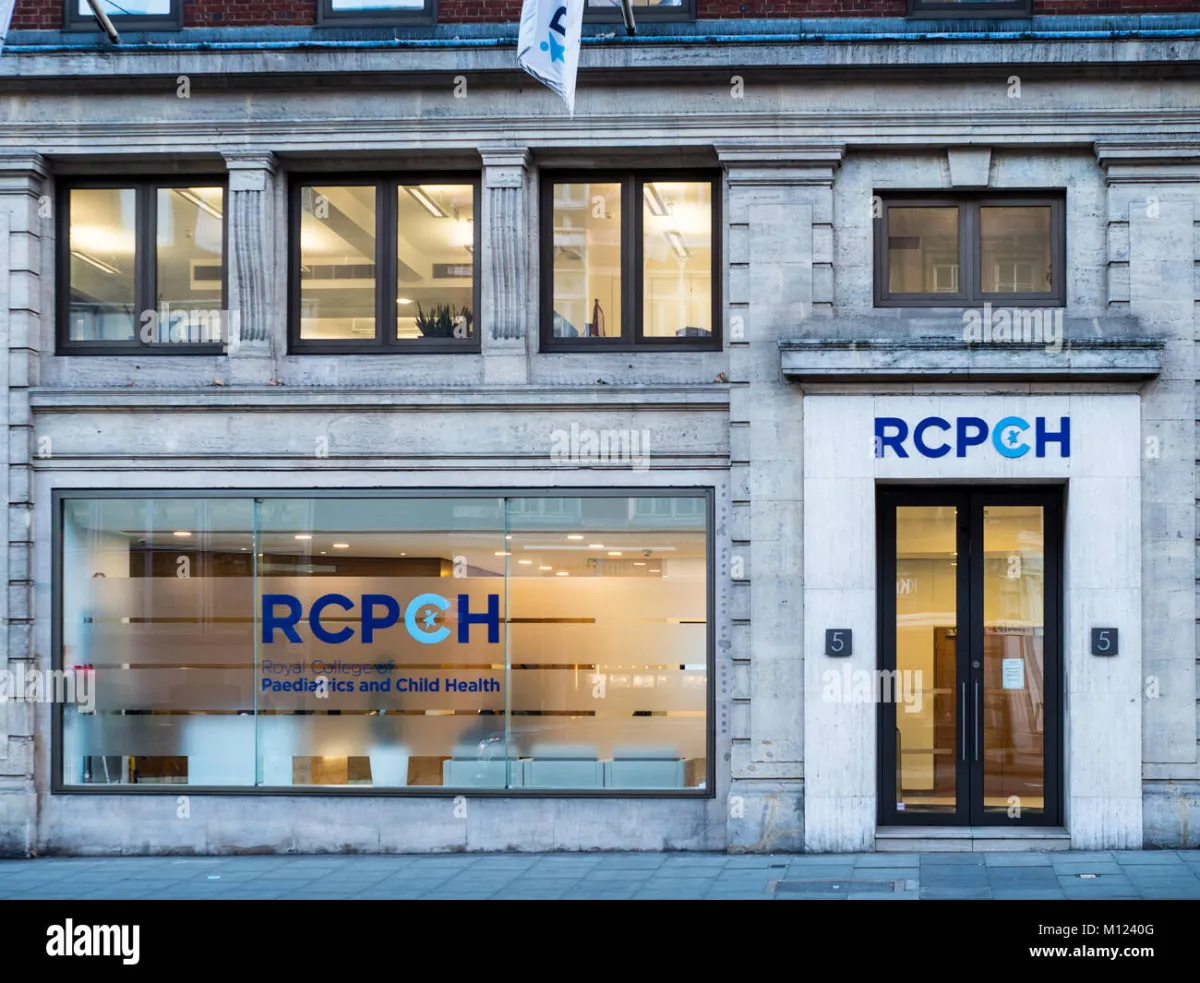 Photo: Royal College of Paediatrics and Child Health, via c8.alamy.com
The educational consequences compound over time. Children from the poorest households arrive at school already behind their peers in language development and school readiness. That gap widens through primary school and becomes entrenched by secondary. By the time these children reach GCSE level, the attainment gap between the poorest pupils and their better-off classmates is measured in years of learning. The promise of meritocracy — that effort and talent determine outcomes — is a statistical fiction for children whose early years were shaped by material deprivation.
The Political Framing That Lets Everyone Off the Hook
The dominant political response to child poverty statistics is, and has been for two decades, a retreat into the language of individual responsibility. Poverty, in this framing, is the consequence of poor choices — worklessness, addiction, family breakdown — rather than the consequence of wages that don't cover rents, benefits that don't cover costs, and a housing market that extracts wealth upward with extraordinary efficiency.
This framing is not merely wrong. It is strategically useful. If poverty is a personal failing, the state bears no structural obligation to remedy it. If it is a systemic outcome, the state is implicated in its production — and obligated to change the systems that produce it. The individualisation of poverty is, at its core, a political project designed to insulate policy from accountability.
Labour's 2024 manifesto promised a Child Poverty Strategy. Months into government, the strategy remains a work in progress, its content opaque and its timeline uncertain. The two-child limit — a policy that the government's own advisers have identified as a primary driver of child poverty — has not been abolished. The political calculation appears to be that the fiscal cost of abolition (estimated at approximately £3.5 billion annually) outweighs the political cost of maintaining a policy that demonstrably harms children. That calculation is morally indefensible and should be named as such.
The Country We Are Choosing to Be
Britain is not a poor country. It is a country that has chosen, through successive policy decisions, to concentrate wealth at the top of the distribution while allowing the floor beneath the poorest families to erode. Child poverty at the scale now documented by the JRF is not a natural disaster — it is the predictable output of a political economy that has never treated the welfare of children as a serious priority when it conflicts with the interests of landlords, asset holders, and low-wage employers.
A meaningful Child Poverty Strategy would abolish the two-child limit, restore Housing Benefit to genuine market rates, expand free school meals universally, and invest in the early years provision that evidence consistently identifies as the highest-return social intervention available. None of this is radical. Most of it existed in some form within living memory. What is radical is the decision to undo it — and to keep it undone while calling the result inevitable.
A country that allows 4.3 million children to grow up in poverty while debating whether it can afford not to is not facing a fiscal constraint — it is making a moral choice, and it is the wrong one.