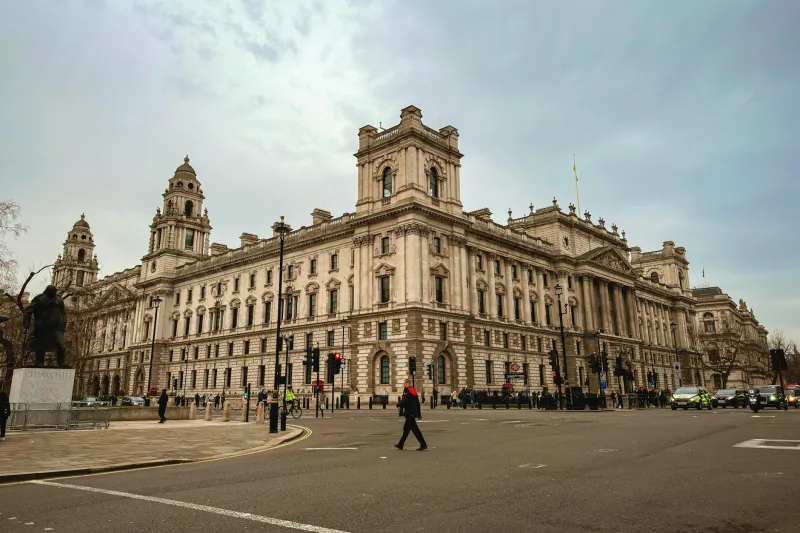
The Ghost of Windrush Lives On
Five years after the Windrush scandal forced Theresa May's resignation and prompted solemn parliamentary apologies, Britain's 'hostile environment' immigration policy remains structurally intact. While politicians across parties distance themselves from the toxic branding, the legislative framework that turned landlords into border guards and doctors into immigration officers continues to operate exactly as designed — excluding, intimidating, and criminalising Black and brown residents in their own country.
 Photo: Theresa May, via www.gloucesterhistoryfestival.co.uk
The evidence is hiding in plain sight. NHS overseas visitor charging rules still demand upfront payments from patients who cannot immediately prove their immigration status. The 'right to rent' scheme continues forcing landlords to check tenants' documentation, creating a parallel system of housing apartheid. Banking restrictions prevent people from opening accounts without Home Office verification. Employment checks make every job application a potential deportation risk.
This is not bureaucratic inertia — it is deliberate policy continuity dressed up as reform.
The Architecture of Exclusion Remains Untouched
The hostile environment was never just about immigration enforcement. It was about embedding racial profiling into the everyday machinery of British life, creating a citizenship hierarchy where some people's belonging could be questioned at any moment. That hierarchy remains operational.
Consider the NHS charging system, introduced in 2017 and expanded every year since. Hospitals must now demand proof of immigration status before providing non-emergency care, with charges ranging from 150% to 200% of standard NHS costs. The policy generates minimal revenue — just £63 million in 2022-23 against administrative costs of over £100 million — but serves its real purpose: making healthcare conditional on proving your right to be here.
The human cost is measurable. Maternity Action reports that pregnant women are avoiding antenatal care due to charging fears. The British Medical Association documents cases of British citizens denied treatment because they cannot immediately produce documentation. Cancer patients have delayed chemotherapy. Children born in Britain have been turned away from GP surgeries.
Yet both Conservative and Labour politicians speak of this system as if it were natural law, not policy choice.
Right to Rent: Apartheid by Algorithm
The 'right to rent' scheme, piloted in 2014 and rolled out nationally in 2016, transformed every tenancy agreement into an immigration check. Landlords must verify tenants' documentation or face unlimited fines and potential imprisonment. The predictable result: systematic discrimination against anyone who 'looks foreign' or has a foreign-sounding name.
Joint Council for the Welfare of Immigrants research shows that 42% of landlords are less likely to consider tenants who do not have British passports, even when they have perfect legal right to rent. One in seven landlords simply refuse to rent to anyone without British documentation. The policy has created a two-tier rental market where British citizens with foreign names face systematic exclusion.
The scheme was ruled discriminatory by the Court of Appeal in 2019. The government's response was not to scrap it, but to launch a 'reformed' version that maintains the same discriminatory structure while adding digital verification. The hostile environment adapts, but never retreats.
Banking on Exclusion
Since 2014, banks must check customers against Home Office databases and freeze accounts of suspected 'illegal immigrants'. This sounds technical until you realise what it means in practice: British citizens with complex immigration histories, naturalised citizens, and legal migrants face arbitrary account closures based on algorithmic flags.
The policy particularly impacts people from Commonwealth countries who gained British citizenship through complex historical routes. Their banking relationships — built over decades — can be severed overnight based on Home Office data matching. Small business owners lose their livelihoods. Families cannot pay mortgages. The message is clear: your citizenship is conditional, your belonging temporary.
Labour's Complicity in Continuity
The most damning aspect of the hostile environment's persistence is Labour's complicity. Despite Keir Starmer's opposition rhetoric, the party has committed to maintaining NHS charging, keeping right-to-rent checks, and preserving employment verification systems. Shadow ministers speak of 'reform' and 'fairness', but refuse to commit to legislative repeal.
 Photo: Keir Starmer, via ichef.bbci.co.uk
This represents a fundamental misunderstanding — or deliberate misrepresentation — of what the hostile environment actually is. It is not a collection of harsh policies that can be softened around the edges. It is a constitutional choice to make immigration status the determining factor in access to basic services. Either you believe healthcare, housing, and employment should be conditional on proving your right to be here, or you do not.
Labour's position suggests they believe conditional citizenship is acceptable, provided it is administered more politely.
The Windrush Generation's Ongoing Trauma
For the Windrush generation and their descendants, the hostile environment's persistence represents a betrayal of every apology and promise made during the scandal. Compensation schemes remain inadequate — just £75 million paid out against estimated damages of over £500 million. But the deeper injury is structural: the system that destroyed their lives remains operational, waiting for the next cohort of victims.
Recent research by the Institute for Public Policy Research shows that Black Caribbean Britons are 50% more likely to be asked for additional documentation when accessing services, despite being British citizens. The hostile environment has trained public sector workers to view Black and brown faces as suspicious, creating a presumption of illegitimacy that no amount of documentation can fully overcome.
Constitutional Choice, Not Administrative Detail
The hostile environment's persistence reveals a uncomfortable truth about contemporary British politics: there is cross-party consensus that some citizens deserve conditional belonging. The policy framework survives because it reflects deeper assumptions about who really belongs in Britain and whose citizenship can be questioned.
This is not about immigration policy — legal migration remains governed by separate systems. This is about whether British citizenship means unconditional access to basic services, or whether some citizens must continuously prove their worthiness to belong.
Until politicians are willing to actively dismantle the hostile environment's legislative architecture — not reform it, not rebrand it, but repeal it — they remain complicit in a system designed to exclude and intimidate Black and brown Britons in their own country.
The hostile environment never ended because it was never intended to — it was designed to become the new normal, and in that, it has succeeded completely.