
The Staggering Scale of Britain's Hidden Hunger
The Trussell Trust distributed 3.1 million emergency food parcels in the year ending March 2024 — a figure that would have been unthinkable just two decades ago when food banks were virtually non-existent in Britain. Yet this represents only the tip of the iceberg, capturing just the largest network in a landscape of over 2,000 independent food aid providers across the UK. What was once considered an American phenomenon — the normalisation of charitable food distribution in wealthy societies — has become entrenched in British communities from Cornwall to the Highlands.
 Photo: The Trussell Trust, via www.greenbelt.org.uk
The most damning statistic is not the raw numbers, but who is using these services. Research by the Joseph Rowntree Foundation reveals that 68% of food bank users are from working households — families where someone has a job but still cannot afford to eat properly. This demolishes the convenient fiction that food poverty is simply about unemployment or personal failings. Instead, it exposes a labour market so degraded that full-time work no longer guarantees the most basic human need: food.
From Emergency Relief to Structural Dependency
Food banks were introduced to Britain in the early 2000s as a temporary safety net, modelled on American soup kitchens but supposedly unnecessary in a country with a comprehensive welfare system. The first Trussell Trust food bank opened in Salisbury in 2000, distributing 150 food parcels that year. By 2024, that single network was providing enough emergency food to feed a city the size of Birmingham for an entire year.
This exponential growth coincides precisely with the implementation of austerity policies from 2010 onwards. The introduction of Universal Credit, with its built-in delays and sanctions regime, created predictable hunger crises that food banks were expected to fill. Local authorities, stripped of funding for emergency welfare assistance, began formally referring residents to food banks — effectively outsourcing the state's duty of care to volunteers and donated tins of beans.
The most insidious aspect of this transformation is how quickly it became normalised. Politicians now speak of food banks as part of the "fabric of communities" rather than as an indictment of policy failure. Job centres display food bank leaflets alongside employment opportunities. Schools stock emergency food supplies for hungry children. What should be a national scandal has been rebranded as civic virtue.
The International Comparison That Shames Britain
Other wealthy nations demonstrate that mass food poverty is a political choice, not an economic inevitability. France, with a comparable economy, has no equivalent food bank infrastructure because it maintains robust social security and minimum wage protections that make such charity unnecessary. Germany's food banks serve primarily recent immigrants and those temporarily between benefits, not millions of working families.
Even the United States, often criticised for its harsh welfare system, provides food stamps (SNAP) to 42 million people as a federal entitlement, recognising food security as a government responsibility. Britain, by contrast, has created a system where charitable food distribution fills gaps that public policy refuses to address.
The UN Special Rapporteur on extreme poverty, Philip Alston, described Britain's reliance on food banks as "patently ridiculous" in a country of such wealth. His 2018 report noted that food banks had become "a growth industry" that "prop up an otherwise failing system" rather than addressing its fundamental inadequacies.
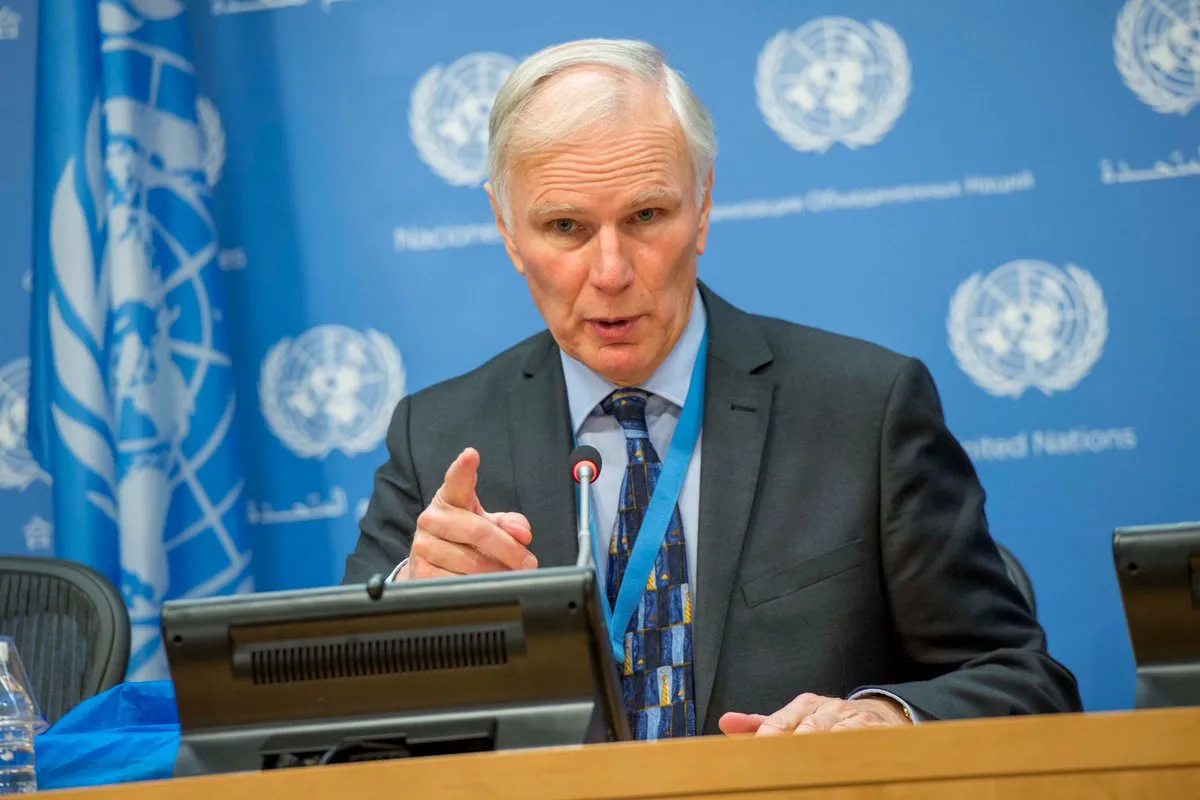 Photo: Philip Alston, via pbs.twimg.com
The Human Cost of Normalised Hunger
Behind every food bank statistic is a family making impossible choices between heating and eating, parents skipping meals so their children can have breakfast, workers cycling to food banks after finishing shifts because they cannot afford both fuel and groceries. The psychological impact of food insecurity — the constant anxiety about where the next meal will come from — affects children's educational development and adults' mental health in ways that reverberate for generations.
Teachers report increasing numbers of children arriving at school unfed, their concentration shot and their behaviour deteriorating as blood sugar crashes throughout the day. The government's own research shows that food insecurity affects 4.7 million children in the UK, yet ministers continue to resist calls for universal free school meals, preferring to rely on breakfast clubs run by charities.
The working poor represent the fastest-growing demographic among food bank users. These are NHS nurses, retail workers, teaching assistants — people providing essential services to society while being unable to afford basic nutrition themselves. The cruel irony is that many food bank volunteers are themselves low-paid workers, donating time they can barely spare to address a crisis their own circumstances could easily tip them into.
The Political Economy of Charitable Hunger
The explosion of food banks serves powerful political interests by providing a pressure valve for economic inequality while avoiding systemic change. Charitable food distribution allows politicians to express sympathy for hunger while maintaining policies that create it. It shifts responsibility from the state to civil society, from public investment to private donation, from democratic accountability to charitable goodwill.
This system also serves corporate interests by keeping wages artificially low. When employers know that food banks will feed their workers' families, they face less pressure to pay living wages. The state effectively subsidises corporate profits through charitable infrastructure, allowing companies to externalise the true cost of labour onto volunteers and donors.
The food industry itself benefits from this arrangement, receiving tax breaks for donating surplus stock while maintaining the artificial scarcity that keeps food prices high. Supermarkets position food bank collection points at store entrances, harvesting positive publicity while continuing business practices that contribute to food poverty.
Beyond Charity: What Food Security Actually Requires
Addressing food poverty requires acknowledging it as a policy problem with policy solutions, not a charitable cause requiring public generosity. Other European countries demonstrate that comprehensive social security, robust minimum wage protections, and universal child benefits can virtually eliminate food insecurity without relying on charitable infrastructure.
The immediate solutions are well-established: increase benefits to reflect the actual cost of living, eliminate the benefit cap and two-child limit, introduce a real living wage, and provide universal free school meals. These measures would cost far less than the current system of in-work benefits that subsidise low-wage employers while leaving families hungry.
The broader transformation requires recognising food security as a human right, not a market commodity or charitable concern. This means treating access to adequate nutrition as seriously as access to healthcare or education — as a fundamental requirement of citizenship that no wealthy society should delegate to charity.
The Verdict on Britain's Charitable Hunger
A country that once fed half the world through its empire now cannot feed its own children without relying on donated tins and volunteer labour — this is not progress but a damning indictment of political priorities that value corporate profits over human dignity.