The Tale of Two Schools
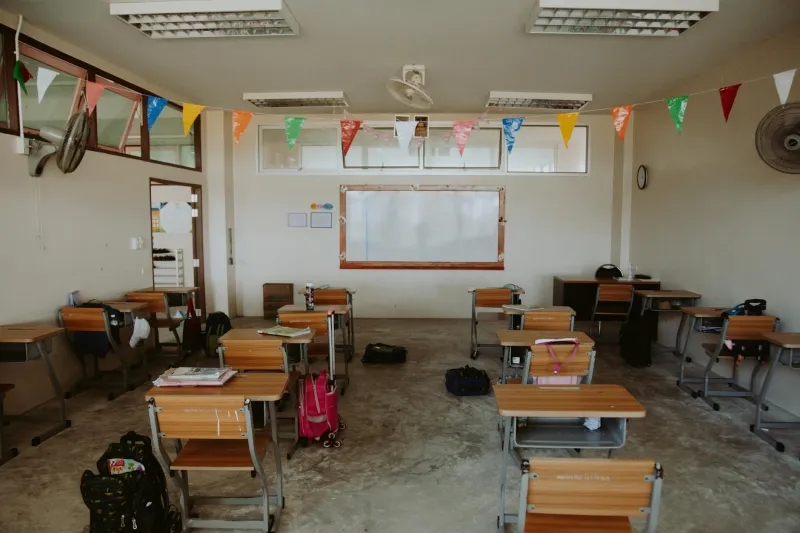
In Birmingham this week, children at a state primary school were evacuated from their classroom when chunks of reinforced autoclaved aerated concrete (RAAC) fell from the ceiling during morning assembly. Meanwhile, 20 miles away at King Edward's School — where annual fees exceed £18,000 — pupils enjoyed state-of-the-art science laboratories funded partly by the VAT exemption that saves private schools millions each year.
This is not coincidence. This is policy.
Britain's education system has become a deliberate sorting mechanism, designed to preserve privilege for those who can afford it while systematically underfunding the schools that serve everyone else. The recent RAAC crisis, affecting over 200 state schools nationwide, is merely the most visible symptom of a decades-long political choice to treat education as a commodity rather than a fundamental right.
The Numbers Don't Lie
The funding disparity is staggering. According to Department for Education figures, private schools spend an average of £15,191 per pupil annually, compared to £6,970 in state schools. But the gap widens when you factor in the hidden subsidies that flow to fee-paying institutions.
Private schools' charitable status exempts them from paying VAT on fees — a subsidy worth approximately £1.8 billion annually to the sector. They also benefit from business rates relief worth hundreds of millions more. Meanwhile, state school spending per pupil has fallen by 9% in real terms since 2010, according to the Institute for Fiscal Studies.
The result? One in four state schools now operates with a budget deficit, forcing headteachers to cut teaching assistants, extend class sizes, and defer essential maintenance. The very maintenance that might have prevented RAAC concrete from endangering children's lives.
International Embarrassment
Contrast this with Finland, consistently ranked among the world's top education performers. Finnish schools receive equal funding regardless of location or intake, private schools are virtually non-existent, and standardised testing is minimal until age 16. The result? Educational outcomes that consistently outperform Britain's, with far lower levels of inequality.
Or consider Germany, where private school attendance hovers around 9% compared to Britain's 7% — but where constitutional law explicitly requires private institutions to avoid creating social segregation. German private schools cannot charge fees that exclude ordinary families, and they receive proportional state funding only if they serve a genuine educational innovation, not mere social exclusivity.
The 'Choice' Myth
Defenders of Britain's system invoke 'parental choice' and 'educational diversity'. This framing is intellectually dishonest. Choice implies genuine alternatives. What Britain offers is a rigged market where your postcode and bank balance determine your child's educational fate.
The 'choice' argument also ignores the collective damage caused by educational segregation. When affluent families exit state schools en masse, they take with them not just their fees, but their social capital, their political influence, and their expectation of excellence. The remaining state schools become increasingly concentrated with disadvantage, making the job of teaching more difficult and perpetuating the cycle.
Research by Professor Francis Green at UCL demonstrates that countries with larger private school sectors tend to have higher levels of educational inequality and lower overall performance. Britain's obsession with preserving elite education actively harms the majority.
Who Pays the Price?
The human cost of this system is measured in lost potential. Children from working-class backgrounds are five times less likely to attend university than their privately educated peers. Those who do make it face an uphill battle in a job market where 65% of senior judges, 59% of Cabinet ministers, and 39% of MPs attended private school.
This isn't just about individual opportunity — it's about democratic legitimacy. How can a society claim to be meritocratic when success is so heavily predetermined by family wealth? How can we speak of social mobility when the education system actively reinforces existing hierarchies?
The RAAC crisis has exposed the physical decay of state education, but the moral decay runs deeper. We have normalised a system where children's life chances are rationed according to their parents' ability to pay.
Labour's Limited Vision
To their credit, Labour has pledged to remove the VAT exemption from private school fees — a policy that could raise £1.7 billion annually for state education. But this alone will not address the fundamental architecture of educational apartheid.
What Britain needs is a comprehensive reimagining of education funding, with per-pupil spending equalised across all schools and additional resources directed to areas of greatest need. We need a constitutional commitment to educational equality, as exists in Germany, and a cultural shift away from the toxic notion that educational excellence requires exclusivity.
Beyond Sticking Plasters
The RAAC concrete now crumbling in our classrooms was supposed to be a temporary solution that became permanent through underinvestment. The same could be said of Britain's entire approach to educational inequality — a series of sticking plasters over a system designed to fail the majority.
Real change requires acknowledging that educational segregation is not a bug in the British system — it's a feature, carefully preserved by those who benefit from it. Until we're willing to dismantle the structures that turn education into a luxury good, we'll continue producing exactly what we've designed: a society where your surname matters more than your potential.
Britain's children deserve better than a lottery where postcodes and private fees determine their futures.